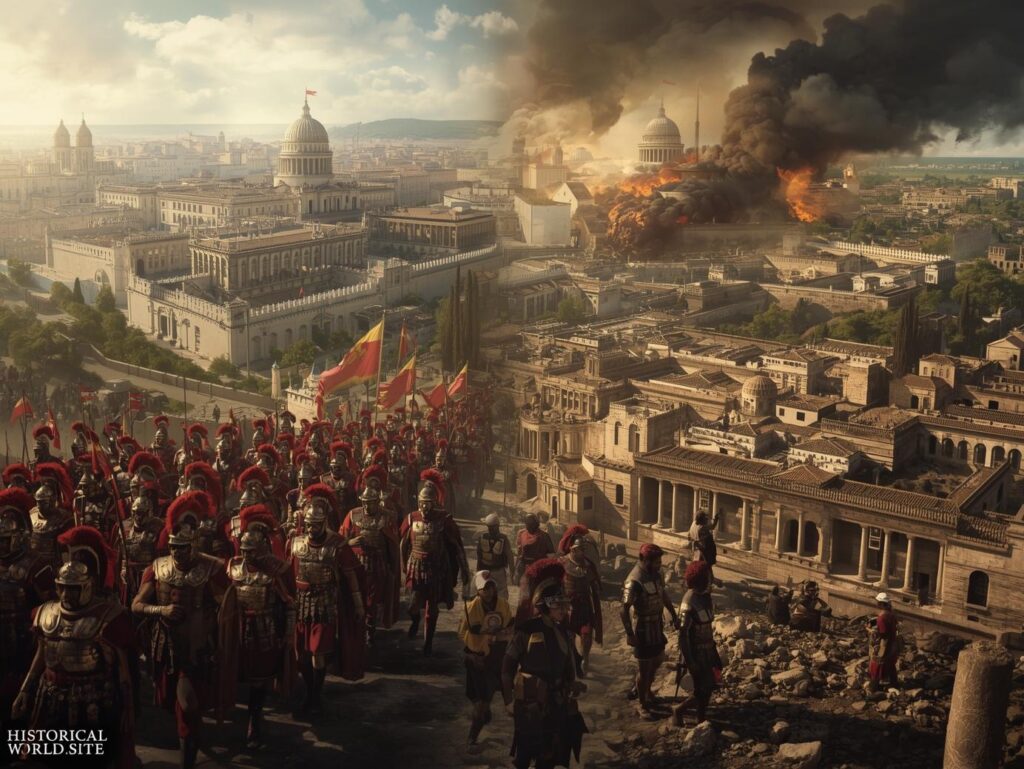

The Roman Empire grew from a city-state in Italy to control territories across Europe, North Africa, and the Middle East. Its expansion relied on military organization, political strategy, and administration. Over time, internal and external pressures led to decline. Studying the empire provides insight into governance, warfare, and society in the ancient world.
Origins of Rome
Rome began as a settlement along the Tiber River. Early social organization included families and clans with defined roles. Leadership evolved from monarchy to republic, establishing elected officials and legal structures.
Early Rome developed alliances with neighboring communities. Agriculture, trade, and military skill supported growth. Governance relied on negotiation, law, and military authority.
Expansion into Italy
Rome expanded through conquest and diplomacy. Neighboring city-states and tribes were integrated through treaties, alliances, or military action. Expansion allowed access to resources, manpower, and strategic positions.
Military organization and discipline enabled Rome to defeat larger forces. Incorporation of conquered peoples into society and military strengthened the state.
Military Organization
Rome maintained legions composed of citizens and allies. Training, discipline, and equipment ensured efficiency in campaigns. Soldiers followed structured command hierarchies.
The army supported territorial expansion, defense, and internal order. Veterans received land or compensation, linking military service to social stability.
Governance and Administration
The Roman Republic and later Empire used a system of officials, councils, and magistrates. Governance involved law enforcement, taxation, and public works.
Provincial administration allowed local oversight while maintaining central authority. Roads, communication, and bureaucracy facilitated control over vast territories.
Economy and Trade
Agriculture formed the economic base. Trade connected cities across Europe, North Africa, and the Middle East. Goods included grain, metals, textiles, and pottery.
Monetary systems, markets, and infrastructure supported economic integration. Trade facilitated cultural exchange and sustained urban populations.
Society and Daily Life
Society included citizens, freedmen, slaves, and foreign residents. Roles were defined by status, occupation, and legal rights. Daily life involved work, family, and participation in civic or religious activities.
Urban centers featured forums, baths, and marketplaces. Rural areas focused on farming, resource production, and local trade.
Religion and Culture
Religion guided law, public ritual, and social expectations. Temples, ceremonies, and festivals structured communal life. Cultural practices included literature, art, and architecture.
Integration of conquered peoples involved accommodating local beliefs. Religion and culture reinforced political and social cohesion.
Expansion Beyond Italy
Rome expanded into the Mediterranean through military campaigns and alliances. Conquests included Gaul, Hispania, Greece, Egypt, and parts of Asia Minor.
Territorial control relied on military presence, administration, and diplomacy. Infrastructure such as roads and aqueducts facilitated governance and communication.
Internal Challenges
Internal pressures included political rivalry, economic strain, and social unrest. Conflicts between elites, corruption, and inequality challenged stability.
Reforms attempted to address distribution of land, wealth, and political power. Resistance to change sometimes led to civil conflict.
External Pressures
Borders faced threats from tribes and rival states. Invasions, raids, and migration stressed military and administrative systems.
Maintaining control required resources, coordination, and strategic deployment. Failure to adapt to external pressures contributed to decline.
Transition from Republic to Empire
Power concentrated in the hands of a single ruler under the empire. Emperors combined military, political, and religious authority.
This shift affected governance, succession, and law. Centralization aimed to provide stability but created dependency on strong leadership.
Decline of the Empire
Decline occurred gradually due to economic, political, military, and social factors. Overextension, corruption, and population shifts weakened control.
Barbarian invasions, civil war, and administrative failure accelerated the process. Western territories fell earlier, while eastern regions persisted longer.
Legacy and Influence
Rome’s legal, political, and infrastructural systems influenced later civilizations. Law, governance, architecture, and language shaped Europe and beyond.
The empire’s history provides insight into the challenges of managing vast territories, integrating diverse populations, and sustaining long-term political and economic systems.
Conclusion
The Roman Empire expanded through military skill, political organization, and diplomacy. It governed diverse territories through structured administration and infrastructure. Internal and external pressures led to gradual decline. Rome’s systems, culture, and influence left a lasting impact on subsequent history.